
Help 1216 and 116
The sizes and weights that push a parcel off the standard form
Thirty kilograms, one hundred and twenty centimetres, seventy centimetres and five kilograms. Four published figures decide whether your parcel goes through the normal submission screen, gets packed on its own, or leaves the standard service altogether.
The search above is for products; the figures below are for the box they arrive in.
Home / Weight, size and the routes out
Three services, in a published order of preference
The order is published, which is unusual. Most operators leave you to guess.
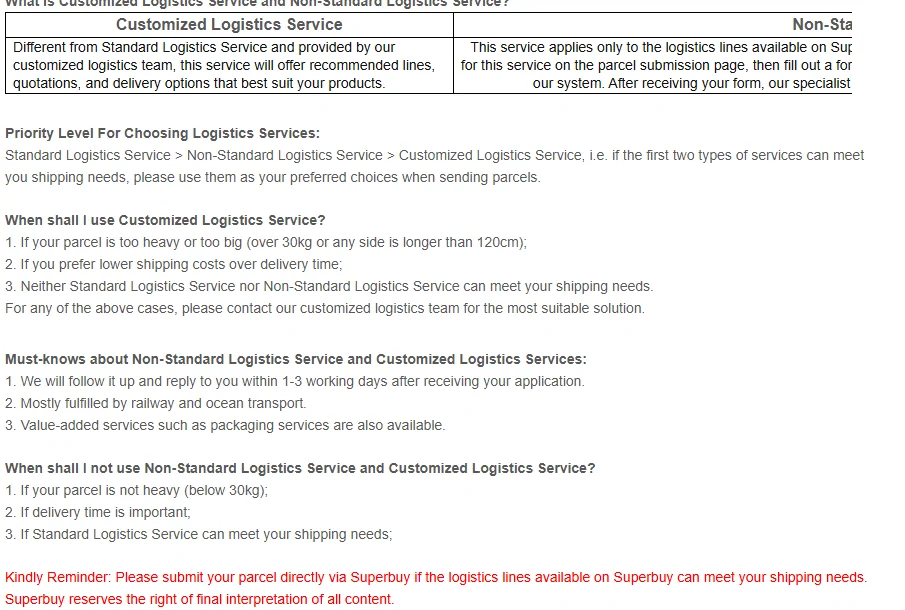
The operator runs three tiers and states the order it wants you to use them in. Standard first, then non-standard, then customized, and the article says so in a single line that reads like an instruction rather than a menu.
Customized is not a premium service. It is where parcels go when the standard form cannot take them, and it works by email rather than by screen. The published conditions are specific.
Shipping and Logisticsupd 2026-10-10
If your parcel is too heavy or too big (over 30kg or any side is longer than 120cm)
Two more conditions follow: when you would rather pay less than arrive sooner, and when neither of the first two services fits.
The must-knows are equally plain. A reply comes within one to three working days, fulfilment is mostly rail and sea, and the article says so before you start. The priority line itself: "Standard Logistics Service > Non-Standard Logistics Service > Customized Logistics Service, i.e. if the first two types of services can meet you shipping needs, please use them as your preferred choices when sending parcels."
The banner above the calculator

The shipping calculator carries the bulk-cargo line across the top, so the routing decision is visible before you have typed a weight. The banner reads: "Send bulk cargo (30kg or more) or oversized items? Try our customized services".
If you are at that size, stop filling in the form. The quote the calculator returns for a parcel it will not accept is not a quote for anything.
Two cards sit under the calculator on the same page, one for a shipping expert service and one for the customized team. Both are doors out of the standard screen rather than upgrades to it.
Lines are not interchangeable, even at the same price
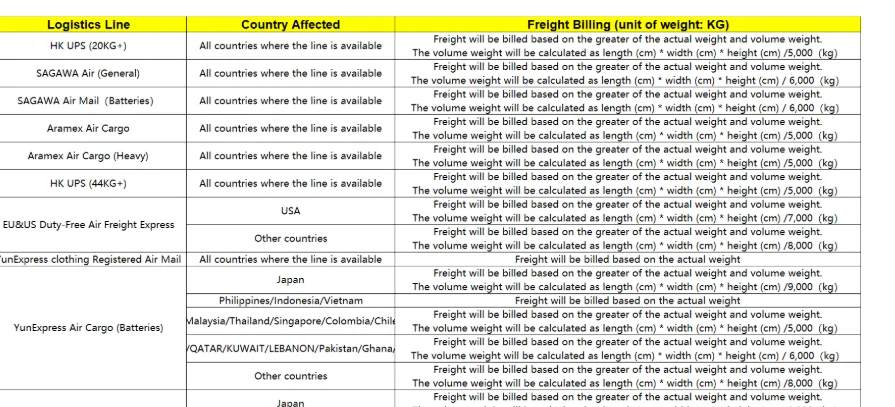
Help 116 publishes a billing rule per line rather than a single house rule. Each entry names the line, the countries it serves, and how that line decides which weight to bill.
The practical consequence belongs on this site rather than on a postage page: a line that refuses your declared value cannot simply be swapped for one at a similar price, because the replacement may bill the same box differently and may serve a different set of countries. Line, destination and declared value have to be chosen together.
What the forwarding page shows side by side
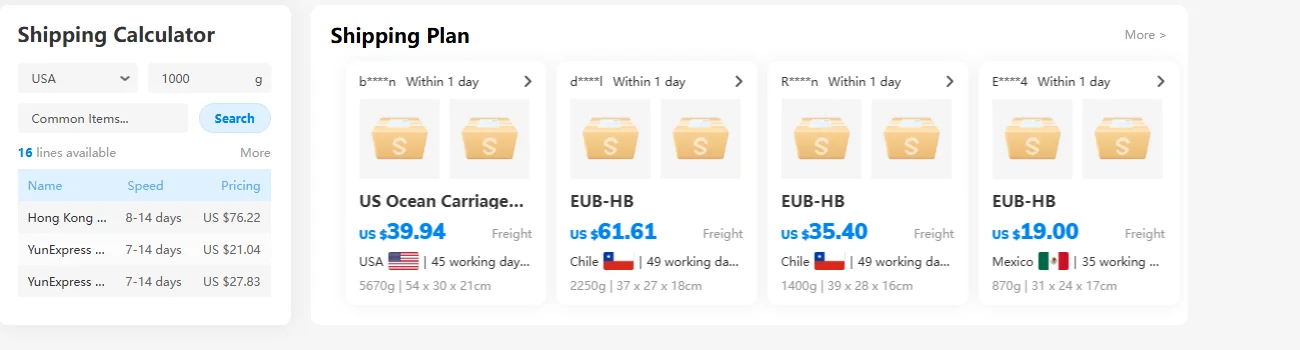
The forwarding screen lists candidate lines as cards with a transit window and a price on each. It is a genuinely useful screen, and it is also where the mismatch shows up: a line can be the cheapest card on the screen and still be the one that refuses your parcel at the declaration step.
The amounts on these cards are the operator's sample values for one query, not a quote for your parcel.
Seventy centimetres triggers individual packing
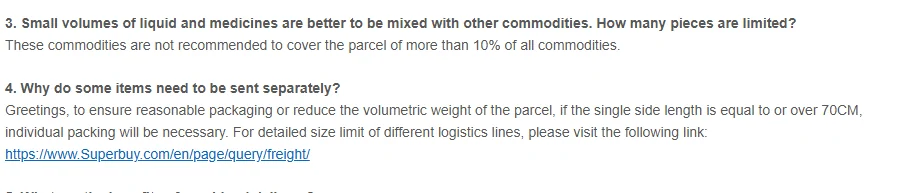
A separate rule governs whether items can travel together at all, and it is a measurement rather than a category. Past a single side length, the item is packed on its own.
Rolled posters, tripods, long boots boxes and guitar cases are the usual cases. The FAQ states it plainly: "If the single side length is equal to or over 70CM, individual packing will be necessary."
The same FAQ answers why a submission can be blocked by one item: if any item in the group is mail-restricted, the others submitted in the same order may be restricted too.
The warehouse measures before it quotes
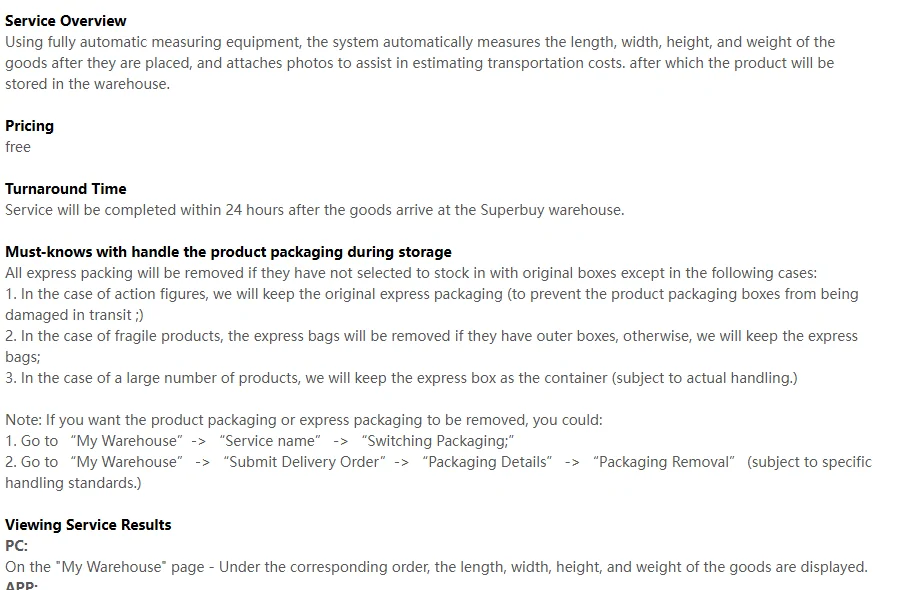
Length, width, height and weight are taken automatically on arrival and photographs are attached, before the item is stored. The service is listed as free and the stated turnaround is within 24 hours of arrival.
This is why the number on your quote differs from the number you estimated. The measurement is the warehouse's, taken on the packed item, and it is what every line rule is then applied to. The same article covers what happens to the original retail packaging during storage, which matters if you are counting on returning something.
Packaging removal is a request you make per order on the submission screen, not a default. Removing it can also move an item outside the return window, which is covered on the cover page.