
Help 1381
Declared value: the caps, the consequences and the conversion
Seventy-four lines, two hundred and forty-two published rows, and one number you type. This page is what the operator publishes about that number, and a panel that reads the table back to you for one destination at a time.
Looking for something to buy first? The search above runs against the catalogue.
Home / Declared value caps by line
What declared value does, and what it does not do
The number is checked twice by two parties who want different things from it.
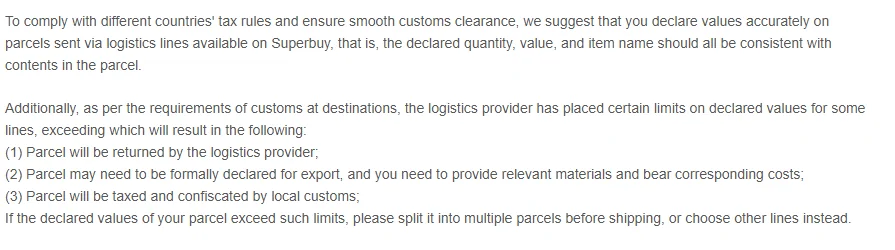
Two different parties read the figure, at two different moments.
The logistics provider checks its own declared-value range before accepting the parcel. Your customs authority separately applies the rules for the goods, destination and shipment date. A value within a route's recorded range does not establish tax-free entry.
It is not a valuation for compensation. Cover is bought separately and has its own insured value, which is a different number with a different ceiling.
Shipping and Logistics > Customs mattersupd 2025-12-23
we suggest that you declare values accurately on parcels sent via logistics lines available on Superbuy, that is, the declared quantity, value, and item name should all be consistent with contents in the parcel.
Quantity, value and item name, all three consistent with what is in the box. The article then lists three consequences of exceeding a line limit and gives one remedy, which is to split the parcel or change the line.
The same article links its own copy of the table as an online document, which is a reasonable sign that it changes often enough to need one.
Compare declared value with the recorded route limits
Choose a destination and enter an accurate value supported by your order records. The panel compares it with the route limits captured in the reference table. It does not calculate current tax or confirm that a route accepts your parcel.
Route limits come from the reference table attached to help 1381, read on 10 October 2026. Treat this as an explanation of how caps differ, then confirm the live route rules before dispatch.
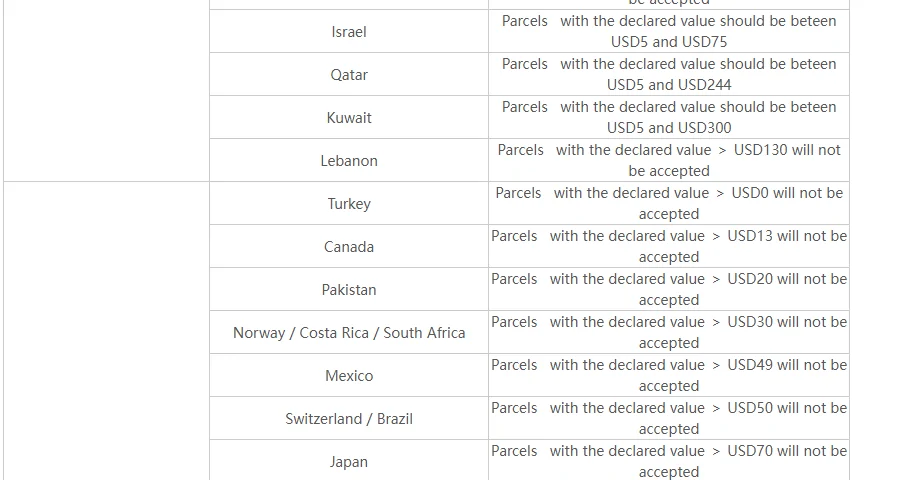
Why the answer is a list and not a verdict
There is no single ceiling per country. The United States has 22 lines with a published limit and they run from USD 59 to USD 999. A figure that closes one door leaves twenty others open, so the useful output is which doors closed, not a yes or a no.
Four lines set a floor as well as a ceiling. For those, a figure that is too low is refused as well, which surprises people who were trying to be careful.
Reading the table the way it is built
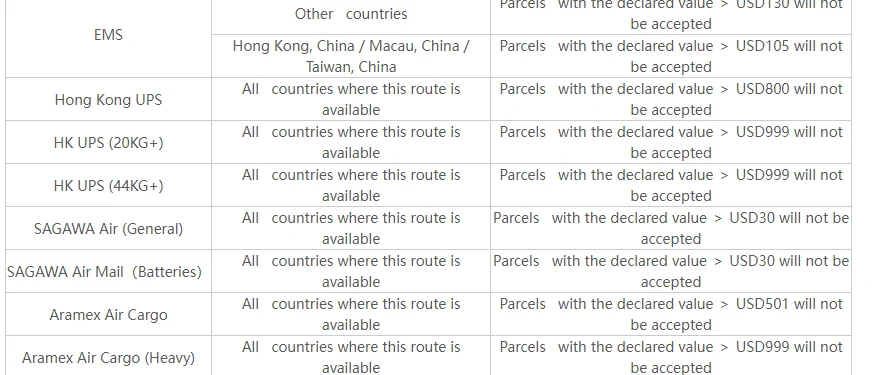
The table is organised by line and then by country, which means a single line can occupy twenty rows. Scanning one column tells you nothing. You have to read the pair.
| Destination | Lines with a cap | Tightest cap | Loosest cap |
|---|---|---|---|
| United States | 22 | USD 59 (YunExpress clothing Registered Air Mail) | USD 999 |
| United Kingdom | 24 | USD 18 (Tax-Free Air Mail (Actual Weight)) | USD 999 |
| Canada | 17 | USD 13 (YunExpress Air Cargo (Batteries)) | USD 140 |
| Germany | 14 | USD 22 (Special Line (Air Cargo)) | USD 999 |
| Japan | 4 | USD 70 (YunExpress clothing Registered Air Mail) | USD 140 |
| Australia | 10 | USD 140 (Europe Duty-Free Air Cargo-B) | USD 650 |
| Singapore | 9 | USD 70 (Southeast Asia Small Parcel Line) | USD 9999 |
| Switzerland | 5 | USD 50 (YunExpress Air Cargo (Batteries)) | USD 800 |
Turkey appears in the table with a limit of USD 0 on two lines, which is the table's way of saying those lines do not serve it. Bahrain, Saudi Arabia, Israel, Qatar and Kuwait are the floor-and-ceiling cases.
The six lines where tax is charged on what you wrote
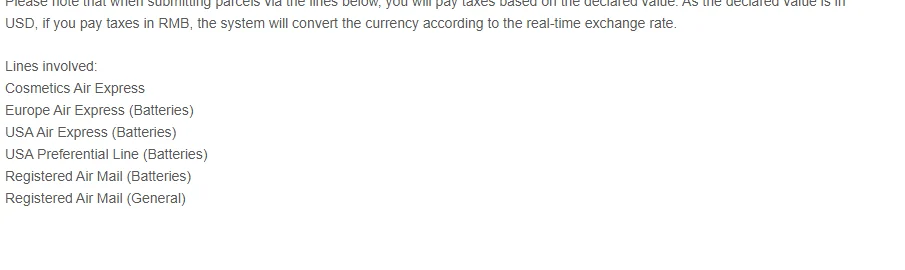
Help 1384 is four sentences long and it names six lines by name: Cosmetics Air Express, Europe Air Express (Batteries), USA Air Express (Batteries), USA Preferential Line (Batteries), Registered Air Mail (Batteries) and Registered Air Mail (General).
On those six, tax is assessed against the declared value, and the declared value is held in US dollars. If the bill lands in yuan, the exchange rate used is the real-time rate at that moment rather than the rate on the day you declared. That is the whole currency story on this site, and it only applies to this handful of lines.
Shipping and Logistics > Customs mattersupd 2023-07-10
As the declared value is in USD, if you pay taxes in RMB, the system will convert the currency according to the real-time exchange rate.
Nothing in the article caps that conversion or promises a rate. If the figure matters to you and you are using one of those six lines, it is worth checking which currency your card is settled in before you submit.
Declared value: the ceiling per route and the fee that follows it
The service charge page prices the declaration itself. It is listed as one of three components of the total, and the figure given is small and flat.
That is worth knowing because it separates two things people conflate. The cost of declaring is fixed and tiny. The cost of declaring badly is a returned parcel, a formal export declaration at your expense, or confiscation, and none of those are priced anywhere.
Operator service charge page, read 2026-10-10: "Customs declaration cost for a parcel is generally RMB 8.00 (Depending on the shipping method)." The totals on the order screen are the operator's sample values.